

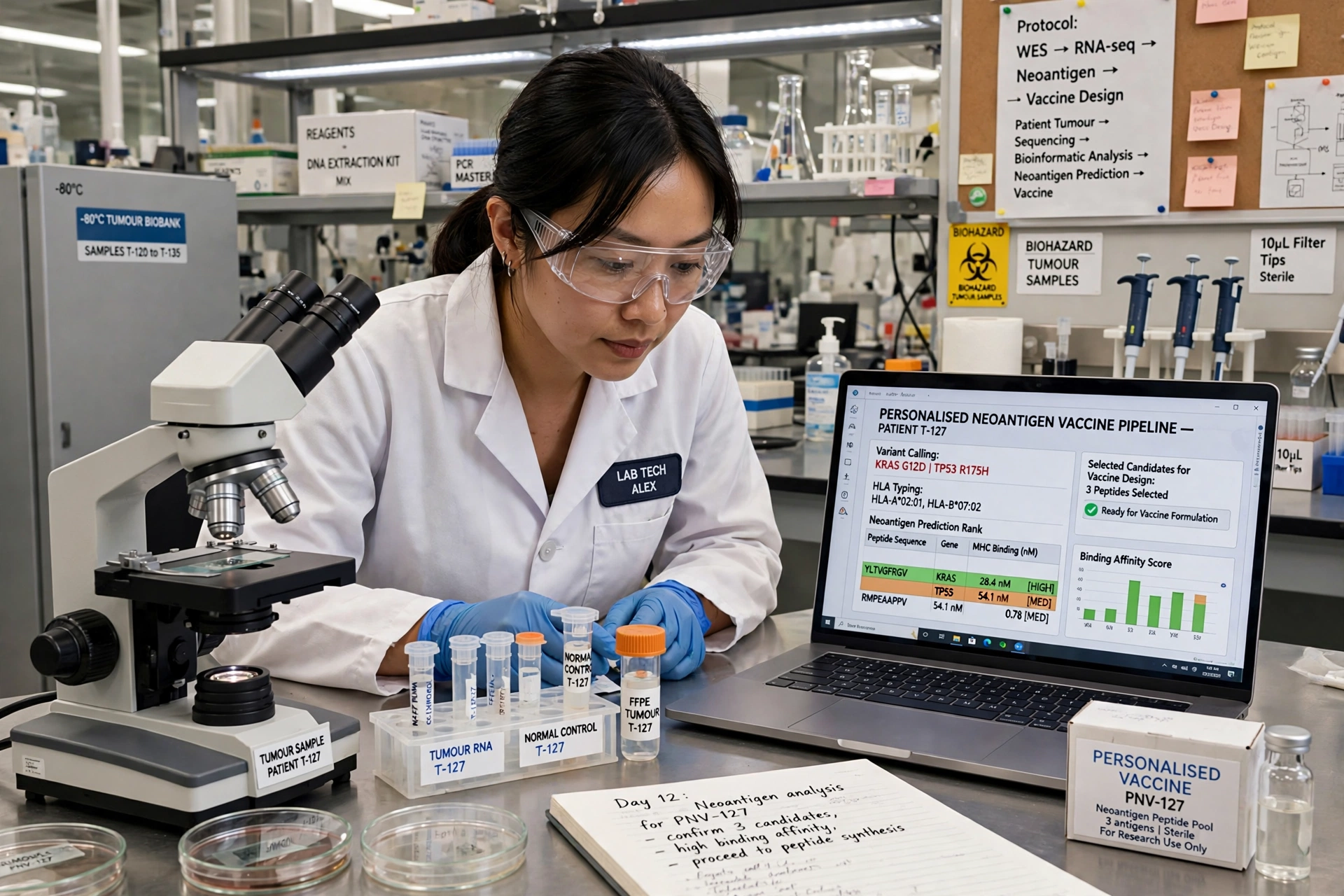
A first-in-patient study of a vaccine made uniquely for each participant has produced the result its designers were hoping for at this stage: the treatment could be made, delivered and tolerated in women with platinum-sensitive ovarian cancer. Published in Nature Medicine, the phase 1 trial paired the personalised neoantigen vaccine NeoVax with nivolumab, a widely used immune checkpoint inhibitor.
The study was not designed to show that the combination defeats cancer, and its authors make no such claim. Its achievement is foundational — evidence that one of the most individualised treatment concepts in oncology can function in practice, on a timetable that real patients can follow.
From tumour sample to tailored vaccine
The process starts when a patient’s tumour is sequenced. Mutations unique to the cancer are identified, and prediction software selects those most likely to generate neoantigens: abnormal protein fragments that the immune system can be trained to recognise. A vaccine is then manufactured containing that patient’s selected targets.
Nivolumab complements the vaccine by blocking PD-1, a receptor cancers exploit to quieten attacking T cells. In theory, vaccination expands an army of tumour-aware T cells, while nivolumab stops the tumour from ordering that army to stand down.
Feasibility is a clinical result, not a footnote
Personalised medicines live or die on logistics. A vaccine that arrives too late, or cannot be manufactured reliably, is of no use however elegant the science. Demonstrating feasibility in this trial therefore matters: it shows the sequence of biopsy, analysis, production and delivery can be completed for patients whose treatment cannot pause indefinitely.
Safety findings were similarly pragmatic. The combination’s side effects were assessed as acceptable, meaning they fell within ranges clinicians can anticipate and manage. As our coverage of AI data centre spending outpacing revenue illustrates in a different sector, early promise always has to survive contact with operational reality; this trial is that contact, made successfully.
Why ovarian cancer needs new ideas
Ovarian cancer frequently returns after initial treatment, and each recurrence narrows the options. Platinum-sensitive disease defines a group whose cancers still respond to platinum drugs, offering a comparatively stable moment at which an immune strategy intended to consolidate control can be tested.
The difficulty is that ovarian tumours are adept at avoiding immune detection. A vaccine built from their own mutation fingerprints sidesteps the problem of finding a universal target: every patient’s vaccine aims at markers that distinguish her cancer from every healthy cell in her body.
What would count as progress next
The next trials must be larger and comparative, tracking recurrence and survival alongside detailed immune measurements. Researchers will want to know which patients mounted the strongest T cell responses and whether those responses corresponded to longer periods without disease progression.
Combination therapy, explained honestly
It is tempting to describe the vaccine-plus-nivolumab pairing as two treatments simply added together, but the design is more deliberate than that. Vaccination without checkpoint support risks generating T cells that the tumour promptly switches off; checkpoint drugs without vaccination rely on immune responses that, in ovarian cancer, may barely exist. The combination attempts to manufacture the response and then protect it — each component compensating for the other’s known weakness.
That logic also explains why interpreting this trial demands restraint. With two active elements given together, no early study can separate their individual contributions, and none is being claimed. What can be said is that the combined strategy was deliverable and tolerable in this group, which is the precise permission slip researchers need to design the comparative trials where the real questions — does it work, and which part matters — can finally be asked properly.
Until such data exist, the honest verdict on NeoVax in ovarian cancer is that the approach is workable and safe enough to justify the harder tests ahead. In drug development, that is not a small thing — it is the gate through which every effective therapy once had to pass.
