

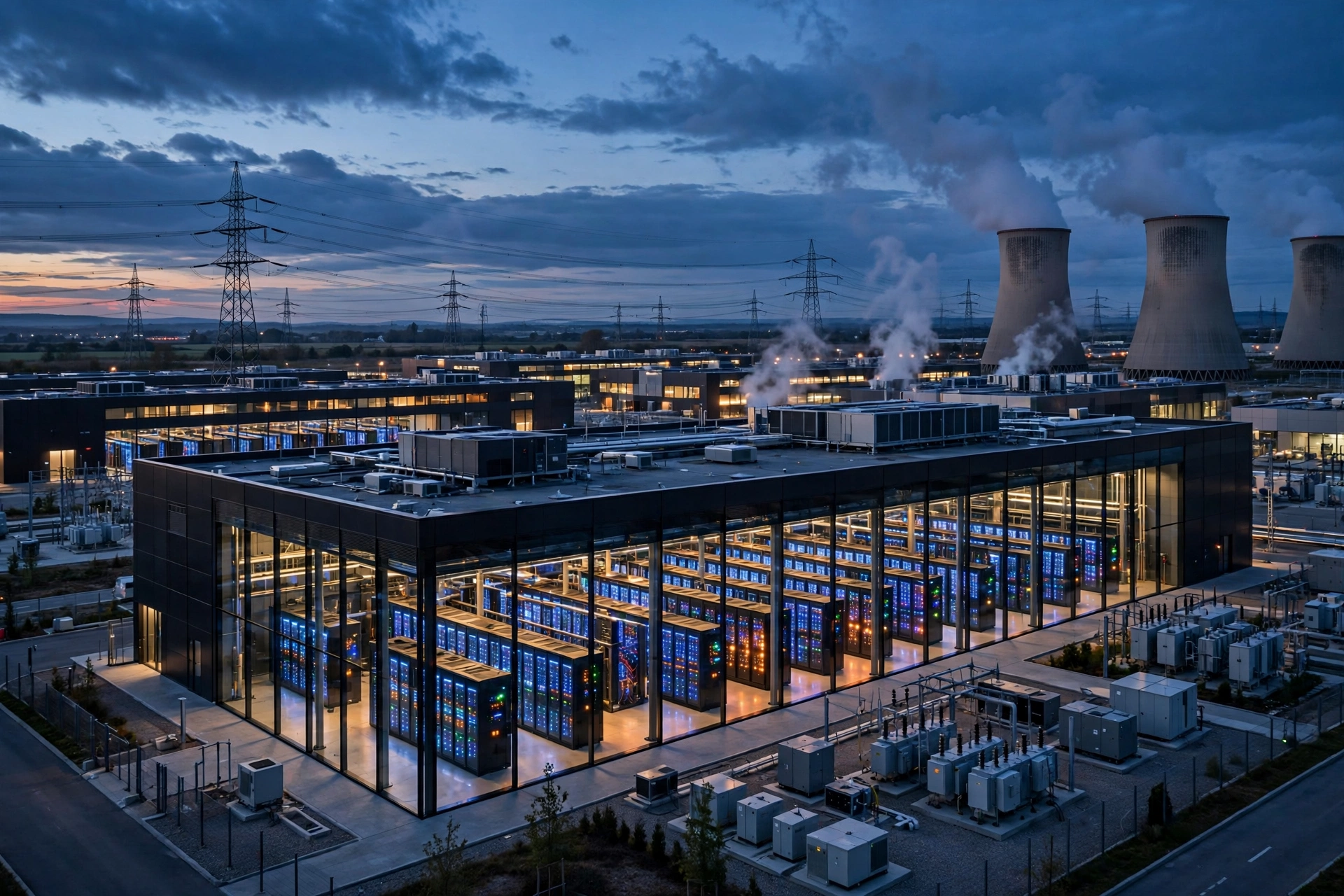
The race to build artificial intelligence infrastructure has become one of the largest spending programmes in technology history. Hyperscale cloud firms, chip makers and a new generation of specialist data center operators are committing hundreds of billions of dollars to servers, networking, land and electricity. Yet a growing number of analysts are asking a simple question: where is the revenue that is supposed to pay for all of it, and how quickly will it arrive?
Reporting this week highlighted forecasts suggesting that infrastructure spending on AI is set to outstrip the revenue the technology is expected to generate in the near term. That does not mean the investment is wasted, but it does change the maths. Data centers are long-lived assets with high fixed costs, and they only make financial sense when they are heavily used, year after year, by customers willing to pay premium prices.
Why the Bills Are So Large
An AI data center is far more expensive than a conventional one. Training and running large models requires dense racks of advanced accelerators, high-bandwidth networking, liquid cooling and a reliable supply of power that many local grids were never designed to deliver. Land near fibre routes and substations has risen sharply in price, and delivery times for transformers, switchgear and generators have stretched in many markets.
Electricity has become the defining constraint. A single large campus can draw as much power as a small city, and operators must secure that supply years in advance. Where grid connections are delayed, companies are signing long-term power purchase agreements, funding new generation, or locating facilities in regions with spare capacity and cooler climates. Each choice adds cost, complexity and political scrutiny.
There is also the pace of change in the hardware itself. New generations of AI chips arrive quickly, offering better performance per watt. That is good for efficiency, but it shortens the useful economic life that accountants can assume for equipment bought today. If a server bought this year is outclassed within three years, the revenue it must earn in that window rises sharply.
Where the Revenue Has to Come From
For the spending to pay off, AI has to move beyond experiments and subscriptions for chat tools into the core budgets of businesses. That is starting to happen in software development, customer support, search, advertising and document-heavy work in finance, law and health care. Our earlier look at AI agents at work and how they are reshaping office jobs shows how employers are testing systems that complete multi-step tasks rather than simply answering questions.
Still, many enterprise deployments remain pilots. Chief information officers want evidence of measurable savings or new sales before signing multi-year contracts, and they are wary of prices that change as models and providers evolve. Consumer revenue, meanwhile, is concentrated in a relatively small number of paid subscribers, while free tiers consume expensive computing capacity every day.
Industry analysis covered by The Register captures this tension: demand for computing is real and rising, but the forecast revenue curve sits below the forecast spending curve for now. The gap is the central risk of the current build-out.
Power, Planning and Public Pressure
Data centers also face questions that have little to do with chips. Local communities ask about water use for cooling, noise, construction traffic and whether new facilities will push up household electricity prices. Planners in several countries are tightening rules for new connections, prioritising projects that bring jobs, use waste heat, or add renewable generation alongside demand.
Those pressures can slow projects, and delays are expensive when equipment has already been ordered. Operators are responding with more efficient cooling, on-site batteries, and designs that can shift flexible workloads to times when power is cheaper and cleaner. Similar advances in computing efficiency are visible in fields such as quantum computing, which is moving from the lab towards real-world problems, where doing more with less energy is the whole point.
What Happens Next
None of this suggests the build-out will stop. Every major cloud provider believes that falling behind in AI capacity is a greater risk than building too much, and demand from governments for sovereign computing capacity adds another committed buyer. What is more likely is a period of sharper discipline: phased campuses instead of single mega-builds, tougher scrutiny of utilisation, and pricing that pushes customers towards more efficient models.
Smaller, specialised models are part of the answer. Many business tasks do not need the largest available system, and running a leaner model on newer hardware can cut the cost per query dramatically. If those efficiency gains arrive faster than spending grows, the revenue gap narrows. If they do not, some facilities could face the fate of earlier technology booms, where the infrastructure eventually proved valuable, just not to everyone who paid to build it.
For now, the AI economy is being built on confidence: confidence that businesses will pay, that power can be found, and that each new generation of models will unlock uses valuable enough to justify the last one. The next two years of earnings, utilisation figures and electricity deals will show whether that confidence was well placed.
