

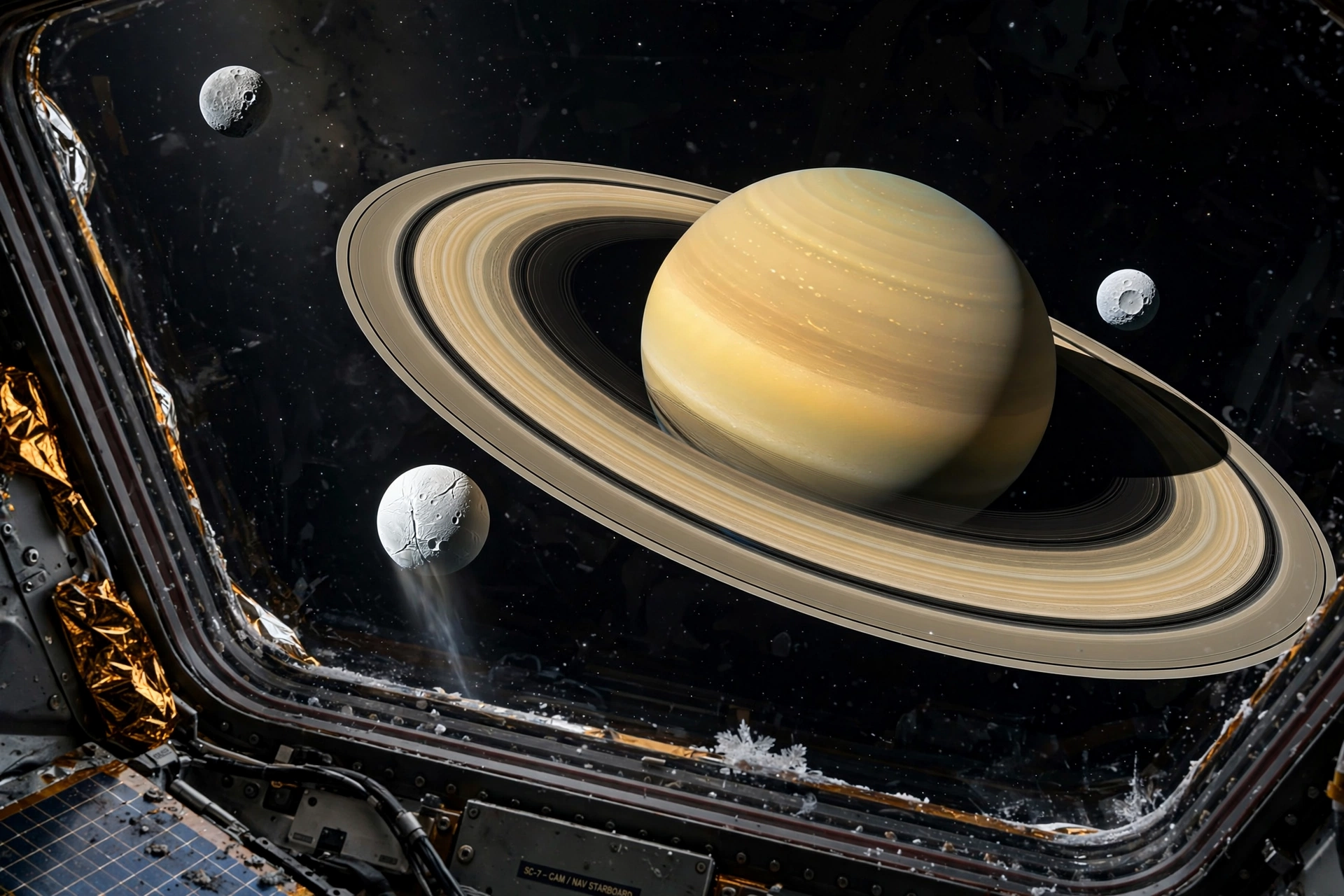
The solar system has a runaway record-holder. Astronomers have confirmed 128 previously unrecognised moons in orbit around Saturn, raising the planet’s official total to 274 and giving it the largest retinue of moons known anywhere. The findings draw on a long-running survey with the Canada-France-Hawaii Telescope and years of follow-up work to secure each orbit.
Among the scientists involved are researchers from the University of British Columbia, who helped detect and characterise the faint population surrounding the planet. With recognition from the International Astronomical Union, the discoveries are now part of the formal catalogue of the Saturn system.
A survey built on patience
Finding these moons is an exercise in endurance. The objects are tiny and dim, shining only by reflected sunlight at an enormous distance. Astronomers stack sequences of telescope images so that anything travelling with Saturn stands out, then return season after season to confirm that a candidate is really in orbit and to refine its path.
That the haul numbers 128 at once reflects the batch nature of the process. Candidates accumulate quietly until enough repeat observations exist for the whole group to be announced together, which is why the confirmed total can jump so dramatically in a single step.
Captured worlds and collision debris
The newcomers are irregular moons, following broad, inclined and frequently retrograde orbits. Their behaviour suggests they did not form alongside Saturn from the same disc of material as its great inner moons. Instead, they are thought to be bodies captured by Saturn’s gravity, with many later shattered into families of fragments by collisions.
Studying those families is rather like crash investigation on a planetary scale. By comparing the orbits of the pieces, scientists can reason backwards to the size of the parent body and, with luck, estimate when the destruction happened. Some proposed families may be younger than expected, hinting at a more restless history than textbooks once described.
Technology behind the tally
Modern surveys succeed because detectors and software have improved as much as telescopes themselves. Techniques that let researchers combine faint signals across many images have opened a window onto objects a generation ago would have been invisible — a story familiar from other fields covered here, such as our trial report on continuous glucose monitors in type 2 diabetes, where better measurement tools changed what questions could be asked.
Saturn pulls away from Jupiter
For decades Saturn and Jupiter traded the lead in moon counts as each new survey reported in. A jump to 274 settles the contest for the foreseeable future and reframes it: the interesting question is no longer which planet has most moons, but how deep Saturn’s population really goes and where it finally fades into undetectability.
Lessons from a decade of looking
The survey behind this announcement offers a case study in how discovery science actually proceeds. There was no single night of revelation. Instead, observers returned to Saturn across many seasons, refined their stacking methods, discarded false candidates and slowly converted suspicion into certainty. The 128 confirmations represent the moment an enormous body of quiet work became presentable as a single result.
That rhythm has practical implications for how future surveys should be funded and judged. Projects measuring faint populations — whether moons, asteroids or distant galaxies — produce their value in batches at the end of long pipelines, not in a steady stream of headlines. Saturn’s record is, among other things, an argument for patience in research: some of the most solid results in astronomy belong to the teams willing to keep looking at the same patch of sky for years, trusting that careful repetition would eventually separate genuine moons from noise, artefacts and wishful thinking.
Future instruments may find more, though probably in smaller batches of even fainter objects. Whatever the final number proves to be, this survey has already delivered its main message — the space around the giant planets is far more populated, and far more informative, than the familiar diagrams suggest.
