

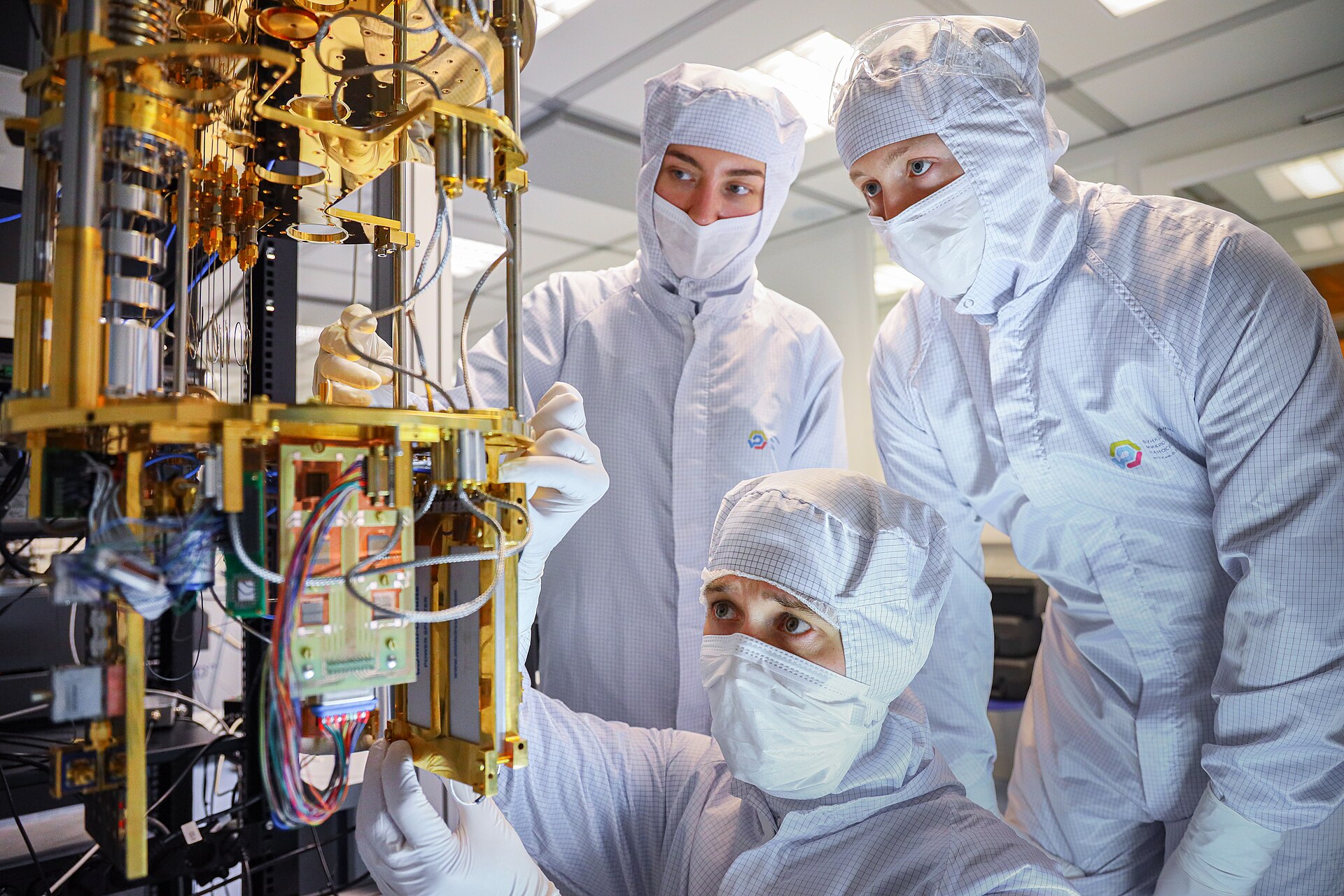
Quantum computers have always carried an embarrassing flaw: the longer they run and the bigger they grow, the more mistakes they make. Qubits, the fragile units of quantum information, lose their delicate states to heat, vibration and stray electromagnetic noise within fractions of a second. Error correction is the field’s answer, and it has now crossed a line that theorists drew decades ago: the point at which adding more physical qubits to protect information actually reduces errors instead of multiplying them.
The milestone, known as operating below threshold, matters because it converts error correction from a hope into an engineering direction. Below threshold, scaling up helps. Above it, scaling up hurts. Teams at several laboratories have reported results consistent with below-threshold behaviour in recent experiments, and the coverage collected on our technology homepage shows how quickly a once-abstract benchmark has become the industry’s central race.
Logical Qubits and the Cost of Protection
The basic trick is redundancy with a quantum twist. Instead of trusting one physical qubit, researchers encode one logical qubit across many physical ones, arranged so that errors can be detected and corrected without directly measuring, and thereby destroying, the stored information. Surface codes, the leading approach, lay qubits in a grid and continually check neighbouring relationships for signs of disturbance.
The cost is steep. Depending on hardware quality, a single reliable logical qubit may require hundreds or thousands of physical qubits. That arithmetic explains why today’s machines, with hundreds or just over a thousand physical qubits, can demonstrate the principle but cannot yet run the long, deep calculations that would make quantum computing commercially transformative. Reporting in Nature on recent demonstrations stresses both halves of that sentence: the physics works, and the scale required remains formidable.
Why Below Threshold Changes the Conversation
Crossing the threshold changes what sceptics and builders argue about. The old question was whether fault-tolerant quantum computing was possible in principle without errors compounding fatally. The new questions are industrial: how fast can error rates be pushed lower, how cheaply can control electronics be built, and which qubit technology, superconducting, trapped-ion, photonic or neutral-atom, scales most gracefully. Each platform now advertises its own road map, and the analysis in our tech section tracks how those road maps differ in their assumptions.
It also changes timelines, cautiously. Below-threshold results do not mean a useful quantum computer is imminent, and researchers are careful to say so. Error correction must still survive longer calculations, faster operations and the messy reality of full systems rather than curated demonstrations. Cryptography, materials simulation and optimisation remain the anticipated first applications, each requiring logical qubit counts far beyond present reach.
The Engineering Decade Ahead
The next decade of quantum computing will look less like physics and more like manufacturing. Cryogenics, wiring density, real-time decoding software and fabrication yield will decide pace as much as new qubit designs. Decoding, in particular, has emerged as a computing problem in its own right: corrections must be calculated faster than errors accumulate, which has drawn classical chip designers and machine learning researchers into the field.
Coverage by Ars Technica of the latest systems captures the mood well: genuine excitement, disciplined by numbers. Below threshold is best understood not as a finish line but as the end of the beginning, the point where the field stopped asking whether error correction could work and started asking how much work it will take. On the evidence of this milestone, the field has both the patience and the physics to do that work, and investors and governments appear ready to fund the long engineering road that still lies ahead of it.
