


When navigating foreign exchange platforms, managing structural transaction costs is just as critical as predicting market direction. Most retail traders start their journey with standard accounts where the bid-ask gap feels completely non-negotiable. However, as trade volume scales, that small visual buffer can quietly erode capital growth. Shifting your terminal architecture to an Electronic Communication Network framework completely transforms your relationship with market pricing, though it requires understanding the structural routing that makes near-zero spreads possible.
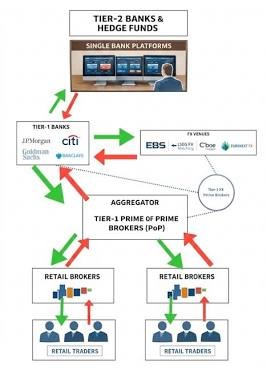
How multi-bank liquidity channels route raw wholesale feeds down to retail terminals. Source: LiquidityFinder
What on earth is an ECN account and how does it route my trades?
An ECN (Electronic Communication Network) account functions as an open digital bridge that bypasses traditional retail broker dealer desks entirely. Instead of acting as a middleman that takes the opposite side of your trade, an ECN broker behaves like a automated matching referee.
Your order commands flow straight into a vast decentralized pool where top-tier global banks, hedge funds, and other independent traders interact concurrently. Think of this setup like a digital wholesale market floor where every merchant displays their truest quotes transparently. Because there is no internal dealer desk standing in the way to redirect your packet, your orders match automatically against the absolute best counterparty quotes available on the global interbank network in real time.
How do ECN setups manage to drop spreads down near zero pips?
Standard retail accounts bundle the broker’s operational padding directly into a wider bid-ask gap on your screen. The bid is the highest price a buyer offers, and the ask is the lowest price a seller will accept. This decimal gap functions exactly like an entry toll or service charge paid just to access the playing field.
ECN accounts strip this retail markup away completely, delivering raw wholesale interbank feeds straight onto your platform layout. Because massive, tier-one institutional banks compete aggressively against each other inside the network to clear volume, their pricing lines collapse together. This intense interbank competition shrinks the visual gap to fractions of a pip. For active day traders, mastering how to calculate spread in forex across these unbundled feeds provides a clear structural baseline to maximize compounding returns.
If the visual spread collapses, how does the broker make any money?
No brokerage firm operates as a non-profit charity, so when they remove the padded retail markup from the bid-ask box, they must adjust their monetization engine. They replace the floating visual buffer by charging a flat, transparent ticket commission fee per standard lot traded instead.
This unbundled billing format gives you complete transaction cost visibility before you ever commit live capital to a trade setup. You exchange the slippery uncertainty of a wider floating spread for a predictable, fixed administrative fee that stays locked regardless of minor market ripples. For anyone executing short-term scalping loops or algorithmic scripts, trading via low spread forex brokers that pass raw feeds along with a separate commission is mathematically superior to fighting an inflated retail markup.
Why do ECN spreads still widen occasionally during major news releases?
The central order matrix behaves like a live thermometer for global financial risk, meaning it responds dynamically to real-time liquidity changes. When a high-impact macroeconomic announcement—like a central bank interest rate shift—hits the economic calendar, market makers face massive pricing imbalances.
To insulate their corporate balance sheets from sudden gaps, institutional bank algorithms quickly pull their resting limit orders out of the electronic matching ledger. This rapid retreat leaves a hollow shell behind inside the centralized order network. When your retail order hits this empty ledger, the platform has to travel across multiple sparse pricing layers to secure a match. The active spread expands defensively like a rubber band, and no amount of advanced network routing can force banks to quote tight pricing during a market panic.
Can my choice of terminal software affect the efficiency of an ECN feed?
The depth of your interbank aggregation layer means very little if your localized user interface lacks the computing power to process high-velocity data. Basic, unoptimized software platforms create internal data bottlenecks, lagging behind the live price matching running on the server side.
Deploying your active strategies through a sophisticated, multi-threaded workspace ensures your frontend can handle rapid quote changes. An advanced setup allows you to view multi-tier Depth of Market (DOM) arrays, visualizing exactly how much volume sits at each fractional pip level. This high-speed visual clarity ensures your technical entry scripts and automated Expert Advisors capture genuine interbank pricing blocks before the order ledger can slip away from your target coordinates.
Is an ECN account structure suitable for a small retail capital balance?
While raw execution models offer undeniable mathematical advantages, they require a higher degree of account discipline and strict capital allocation. Because ECN networks operate on direct interbank lines, minimum deposit requirements are traditionally higher than standard retail accounts.
Furthermore, you must calculate your position sizes carefully to ensure your remaining free margin absorbs separate commission charges without triggering automated stop-outs. If you maintain a highly compact balance and hold swing positions over multiple weeks, the administrative simplicity of a standard markup account might suit your routine fine. However, if you are scaling your volume and execute multiple intraday positions, the ECN matrix serves as your ultimate tool to eliminate silent fee leakage.
Practical Action Plan
Stop treating your trading platform’s transaction fees as an abstract, unchangeable detail on your monitor. Pull your execution history logs from the past month, calculate your aggregate lot volume, and cross-reference your net returns against your broker’s pricing model. By migrating your active portfolio to an unbundled raw ECN account configuration and restricting your high-volume entries strictly to peak session overlaps when bank competition is dense, you can eliminate structural transaction drag and run your trading business with absolute mathematical precision.
