

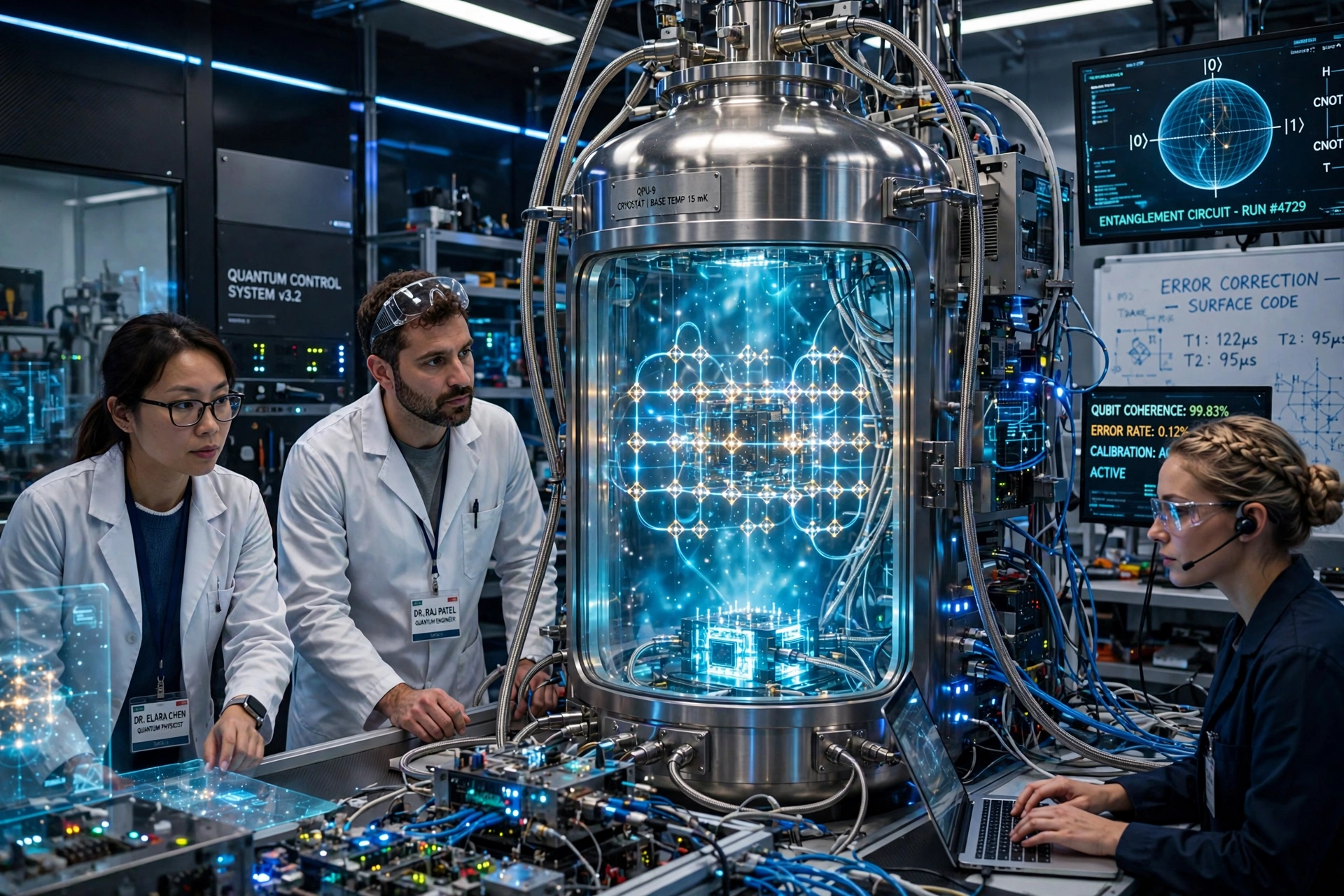
Quantum computing has spent years as a promise discussed mainly in laboratories and research papers. That picture is changing. Progress in error correction, larger and more stable processors, and experiments that can be checked against classical methods are moving the field towards problems that matter outside physics departments. The shift is gradual rather than sudden, but it is real, and it is reshaping how governments, companies and researchers plan for the next decade.
Why Error Correction Is the Turning Point
A classical bit is either zero or one. A qubit can hold a more delicate quantum state, which gives quantum machines their potential power but also makes them fragile. Heat, vibration and stray electromagnetic signals can disturb that state in fractions of a second. For years, this fragility meant that adding more qubits did not reliably mean getting more useful answers.
Error correction addresses the problem by spreading one unit of useful information — a logical qubit — across many physical qubits. The system constantly checks for signs of error without directly measuring and destroying the underlying calculation. Recent work has focused on making those checks faster, more efficient and less wasteful. New codes, including approaches that need far fewer physical qubits per logical qubit, and decoders that can keep up in real time, are central to the latest progress.
Research from IBM and the University of Chicago on logical quantum circuits illustrates the direction of travel: larger encoded circuits, results that can be verified, and a clearer test for whether a quantum machine is doing something classical systems cannot practically reproduce. Verification matters as much as raw speed. A result that cannot be trusted has little value in chemistry, finance or engineering, however fast it arrives.
Where Real-World Use Cases Are Emerging
Chemistry and Materials
The most natural early applications remain chemistry and materials science. Molecules are quantum systems, so simulating them on a quantum machine can be more direct than approximating them on a classical supercomputer. Researchers are exploring catalysts that could make fertiliser production less energy-intensive, battery materials with better density and lifespan, and compounds that might become new medicines. These are not overnight breakthroughs. Even useful simulations will need to be combined with laboratory testing and classical computing, but better molecular modelling can narrow the search before expensive experiments begin.
Logistics and Optimisation
Logistics is another frequently cited area. Airlines, shipping firms and retailers face optimisation problems with enormous numbers of possible routes, schedules and constraints. Quantum algorithms may eventually help explore those choices more efficiently, particularly when combined with classical optimisation tools in hybrid workflows. The realistic near-term model is not a quantum computer replacing existing systems, but a quantum processor handling a specific hard sub-problem while conventional software does the rest.
Other Sectors Watching Closely
Energy grids, manufacturing and financial modelling are also being studied. In each case, the test is the same: can a quantum approach produce a measurably better or faster answer for a problem that is genuinely difficult, at a cost that makes commercial sense? Many proposed uses will fail that test for years. The ones that pass are likely to appear first in research partnerships and specialist cloud services, not as desktop machines.
Read also on TechDemis: A Guide for Competitor Analysis: Learning from Backlinks and Search Visibility
Read also on TechDemis: Exploring the Modern World of Online Games and Digital Entertainment
Realistic Timelines, Not Hype
Roadmaps from major developers point towards larger fault-tolerant systems towards the end of this decade, with meaningful scaling in the early 2030s if error correction continues to improve. That timeline should be read with caution. Hardware milestones have slipped before, and a machine with many logical qubits still needs software, skilled users and a problem worth solving. Progress is best judged by logical qubit quality, error rates and reproducible results, not by headline qubit counts alone.
There are also consequences to prepare for now. Large fault-tolerant quantum computers could eventually threaten widely used forms of encryption, which is why governments and technology firms are already migrating towards post-quantum cryptography. That work does not require waiting for a perfect quantum computer; it requires acting before one arrives.
What to Watch Next
The next signals to watch are practical: logical qubits that stay reliable for longer circuits, error correction that uses fewer resources, independent replication of claimed advantages, and paying customers returning because a quantum workflow helped with a real problem. If those continue to accumulate, quantum computing will stop being mainly a laboratory story.
For now, the honest summary is encouraging but measured. Quantum computing is moving from the lab towards real-world problems — not by replacing classical computing, but by slowly earning a place alongside it for the hardest calculations in science and industry.
