

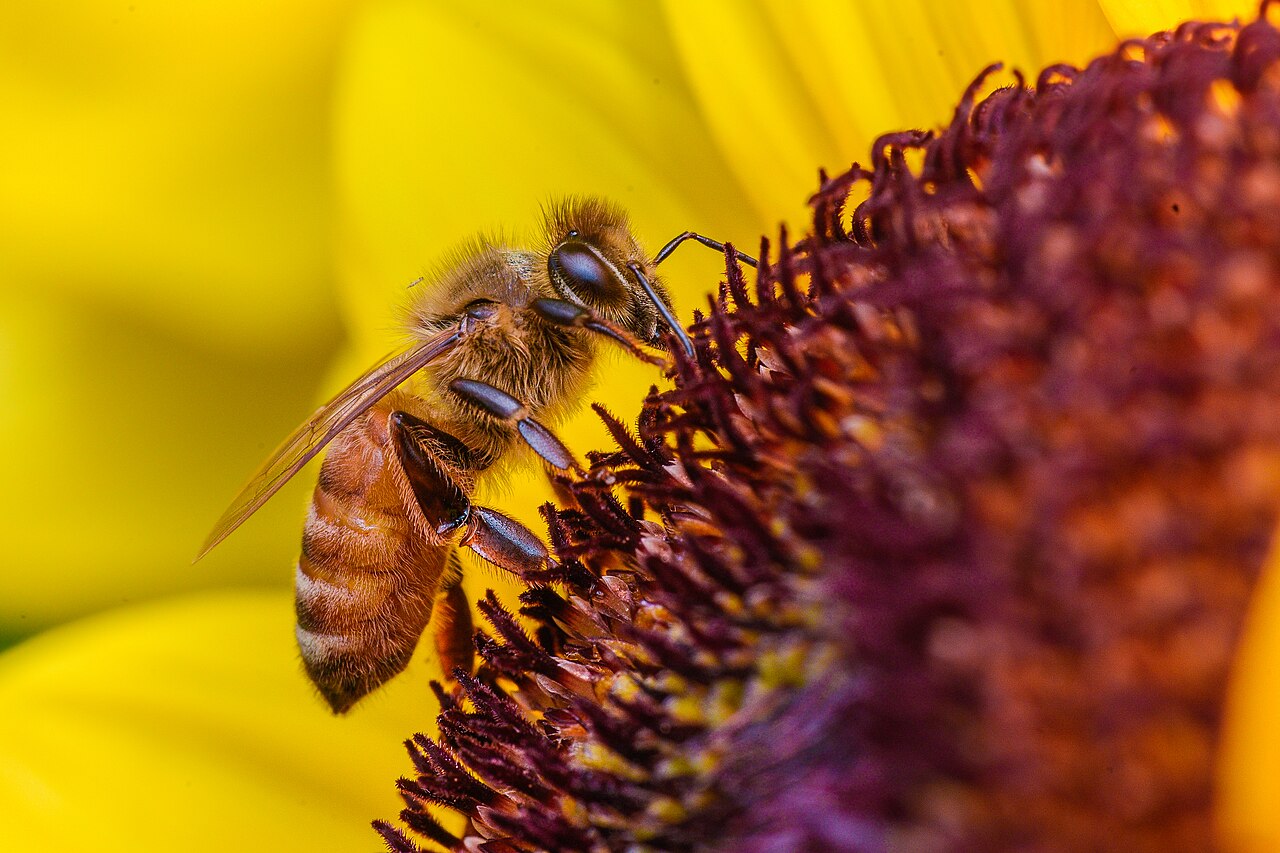
A honeybee that leaves its hive on a cloudy morning can travel several kilometres, visit hundreds of flowers and still fly home in a nearly straight line. How such a small insect, with a brain smaller than a sesame seed, manages this feat has fascinated scientists for decades. Research now shows that bees combine several navigation systems at once: the position of the sun, patterns of polarised light in the sky, familiar landmarks and even a sense of distance travelled.
Reading the Sky Like a Compass
The bee’s primary compass is the sun. Specialised cells in its eyes detect polarised light, which forms predictable patterns across the sky even when the sun itself is hidden behind cloud. By reading those patterns, a bee can work out the sun’s position and hold a steady course. Remarkably, bees also allow for the sun’s movement across the sky during the day, adjusting their internal compass as the hours pass so that a direction learned in the morning still makes sense in the afternoon.
Distance is measured differently. Experiments in which bees flew through tunnels with patterned walls showed that they estimate how far they have travelled by watching how quickly images move across their eyes, a measure scientists call optic flow. When a successful forager returns home, it shares this information through the famous waggle dance, whose angle indicates direction relative to the sun and whose duration indicates distance. Other bees decode the dance and fly out to the same food source.
Landmarks, Memory and Mistakes
Close to home, bees rely more on what they can see. They memorise the arrangement of trees, buildings and hive entrances during orientation flights early in life, gradually widening the circles they fly around the colony. Studies described by research organisations such as Nature show that bees can also learn routes, shortcuts and the timing of when particular flowers produce nectar, building a daily schedule around the most rewarding stops.
Bees do get lost. Strong winds can blow them off course, unfamiliar landscapes can confuse their landmark memory, and artificial light and some pesticides appear to interfere with navigation and learning. Those errors are scientifically useful: they reveal which cues matter most when systems disagree. When the sun compass and landmarks conflict in experiments, bees often compromise, flying a direction between the two, which suggests their brains weigh evidence much as larger animals do.
Understanding bee navigation is more than a curiosity. Bees pollinate a large share of the world’s food crops, so knowing how they move through farmland helps growers place hives and plant flower strips where they will do most good. Engineers, too, study bees for inspiration: a robot that navigates with a simple sky compass and a camera, rather than satellites and heavy computing, could be cheaper and more resilient. The bee, it turns out, is an excellent teacher in travelling light.
